

About us
Head Teacher’s Welcome
At The Stonebridge School our children are at the heart of all we do. We believe that a strong sense of self, along with high quality teaching and an exciting and ambitious curriculum will develop every child’s passion to ‘learn for life’ where they can discover their individual strengths and talents within and beyond the classroom; thus ‘finding their element’.
We put learning at the heart of everything we do so that the children from their starting points achieve academic and social success whilst at our school. The Stonebridge School is a community school for 3 -11 year-old children.
I am very proud to be the Head teacher of a community I love; in an area I grew up in. You are very welcome to come and see our school as well as explore our website to discover more about our values our school as well as our determination for your child’s educational journey.
Appointments can be arranged with our office team.
I welcome you to The Stonebridge Family.
Warmest wishes,
Leena Pacquette – Head teacher

Our Vision and Ethos
At The Stonebridge School, we are passionate about all pupils ‘learning for life’ to ensure happy, highly achieving and confident citizens of the world.
From nursery to Year 6, we help our children embed TRACK so that they develop Tenacity, Respect, Ambition, Character and Kindness. Our ethos and values are at the core of everything we do. They underpin our relationships, teaching and learning, and the environment which prepares our pupils to flourish in all situations.
Our dedicated team work very hard to give all our children experiences that provide them with a fantastic start in life Our staff have a range of development opportunities and are encouraged to continually improve by applying latest learnings so every child at The Stonebridge School is inspired creatively, challenged academically and nurtured in their emotional development.
Tenacity

Respect

Ambition

Character

Kindness

The Governing Board is a group of volunteers who, alongside with the school’s leadership team, set the strategic direction for the school. Our governors are committed to the ethos and values of our school are well informed and active.
Our Governors work together to carry out their core functions:
- Ensuring there is clarity of vision, ethos and strategic direction
- Holding leaders to account for the educational performance of the organisation and its pupils and the performance management of staff
- Overseeing the financial performance of the organisation and making sure its money is well spent
- Ensuring the voices of stakeholders are heard
- Our Governing Board comprises of parent, staff, community and local authority representatives
The Board is split into two main sub-committees:
- Curriculum and Standards Committee
- Finance, Personnel, Premises and Resources Committee
Each committee meets 3 times a year with a full board meeting 4 times a year. In addition to this, governors visit the school termly to see the school in action. Should you wish to contact a member of the Governing Board, please do so through the school office who will share the contact to the Clerk to the Governors. You can also speak to the parent Governors who are easily accessible.
- Chair of Governors: Tara Furlong
- Chair of the Finance, HR and Resources Committee: Chris Eracleous
- Co – Chairs of the Curriculum and Standards Committee: Ines Taylor & William Richards
Becoming a Governor – Are you interested in becoming a Governor at The Stonebridge School?
If you are the parent or carer of a child at the school, you can stand in the next parent governor election. All eligible parents and carers are invited to stand for election as parent governors when a current parent governor’s term ends. You can nominate yourself or ask someone to nominate you.
If you are a member of staff, you can stand in the next staff governor election. All staff are invited to stand for election as staff governor when a current staff governor’s term ends.
Co-opted governors are appointed by the Board of Governors, if you are interested in becoming a Co-opted Governor you should contact Brent Governor Support. LA Governors are appointed by Brent Local Education Authority.
If you would like a paper copy of any information found on the website, please contact the school office.
Membership of the Governing Board at The Stonebridge School
| Tara Furlong | Chair of the Governing Board (Co-opted) |
| Penny Witham | Curriculum & Standards Committee (Co-opted) |
| Simon Topping | Clerk to Governors |
| Chris Eracleous | Finance, Personnel & Premises Committee (Chair) Pay Committee |
| Ines Taylor | Finance, Personnel & Premises Committee Curriculum & Standards Committee (Co-Chair) |
| William Richards | Curriculum & Standards Committee (Co-Chair) |
| Daniela Guebli | Curriculum & Standards Committee (Parent Governor) |
| Leena Pacquette | Head Teacher (Ex-Officio) |
| Simon Defoe | Finance, Personnel & Premises Committee Pay Committee |
| Susan Jarrett | Curriculum & Standards Committee (Staff Governor) |
| Sharon Moore | Finance, Personnel & Premises Committee Curriculum & Standards Committee (Staff Governor) |
| Rohit Dey | Finance, Personnel & Premises Committee (Associate Governor) |
| SP GB DoI & attendance for publication Autumn 2025 |  |
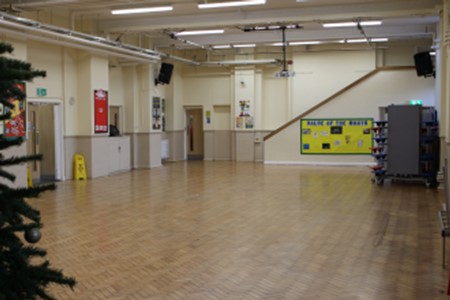
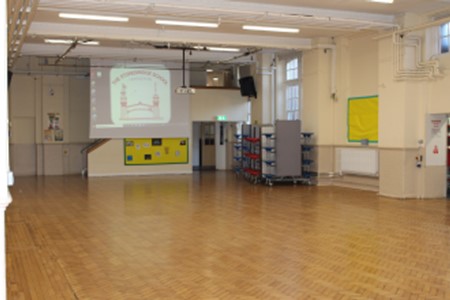
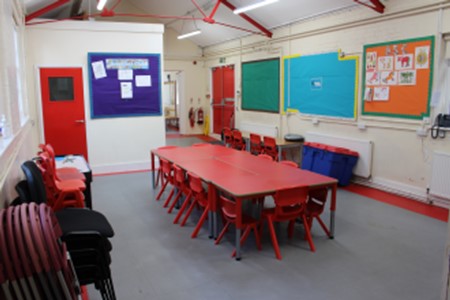
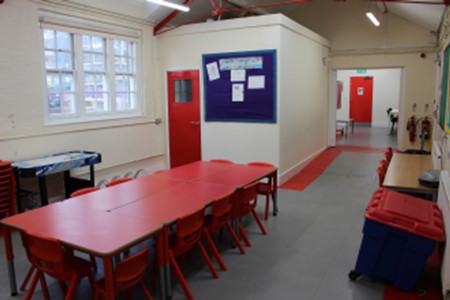
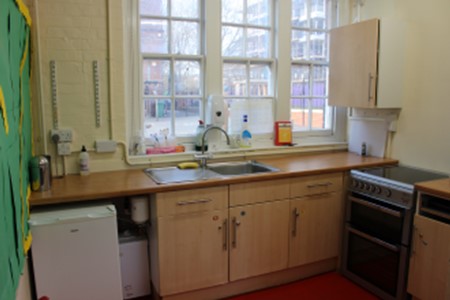
At The Stonebridge School, we have many spaces that are available to hire. We have a number of facilities that are great for:
- Football Clubs
- Netball Clubs
- Weddings
- Birthday parties
- Keep fit classes – Pilates, Zumba
- Sporting events
- Drama/Music classes
- Martial arts
- Business meeting events plus much more!
Whatever your needs are, The Stonebridge School is the ideal venue for your event!
By hiring our facilities we can also offer you…
- Audio-visual equipment for your event
- A dedicated member of the team to manage all aspects of your booking
- Limited free parking onsite. Plenty of parking off street
- Excellent location with each access roads and Harlesden and The Stonebridge School (Bakerloo Line) being only a 7 minute walk from the school
Facilities are available to hire at these times:
- Monday-Friday, 5:30pm-11pm
- Weekends 7am-12am
To enquire about the availability of our facilities or to make a booking, please
contact the school via the admin email admin@stonebridge.brent.sch.uk
Kitchen facilities are available for warming. Hot servers and urns are available
at an additional cost.
HIRERS MUST PROVIDE PUBLIC LIABILITY INSURANCE
Pictures of our Facilities
Main School Hall
Learning Resource Centre
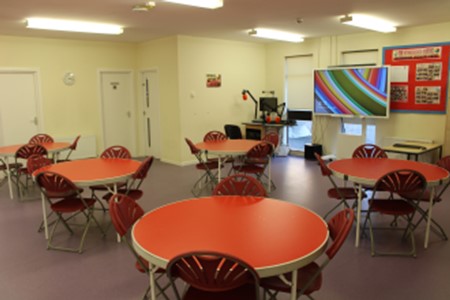
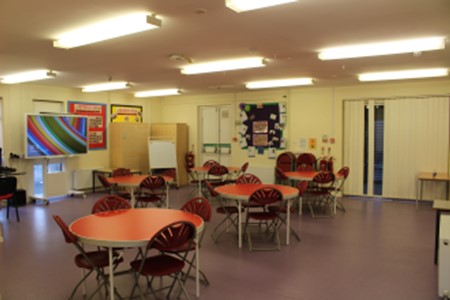
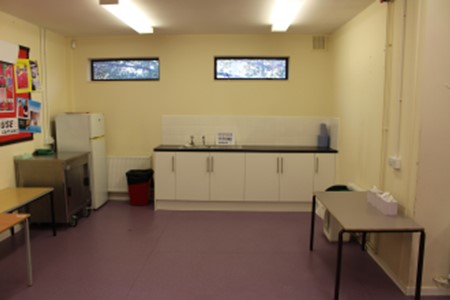
Ann John Centre
OUR HISTORY
Until the Elementary Education Act of 1870, education was largely left to voluntary initiatives, with the churches or local charities as the main providers for the poorer classes. The Act, steered through Parliament by William Forster and thus known as ‘Forster’s Act’, actively supported by Gladstone, was the first to set a national, secular framework for the education of children aged 5-13.
Join Us / Vacancies
The Stonebridge School is committed to safeguarding and promoting the welfare of children and young people and requires all staff, governors, and volunteers to share this commitment.
All applicants for employment will be required to complete an Application Form containing questions about their academic
and employment history and suitability for the role.
Applicants will receive a Job Description and Person Specification for the role applied for.
References will be taken up for all short-listed candidates prior to interview. We welcome applications from both men and women of all ages from any background and from candidates with disabilities.
Applicants to be advised that due to the nature of the work, The Stonebridge School applies for criminal record certificates from the Disclosure and Barring Service (the ‘DBS’) in respect of all prospective employees, Governors and volunteers.

Until the Elementary Education Act of 1870, education was largely left to voluntary initiatives, with the churches or local charities as the main providers for the poorer classes. The Act, steered through Parliament by William Forster and thus known as ‘Forster’s Act’, actively supported by Gladstone, was the first to set a national, secular framework for the education of children aged 5-13. A driving force behind the Act was the need for a literate and numerate workforce to ensure that Britain remained at the forefront of manufacture and improvement. It required partially state-funded elementary schools to be set up in areas where existing provision was inadequate, to be managed by elected school boards. The churches and other pressure groups had opposed state-provided education. Reactionary opinion generally favoured church schools, and was concerned that secular and radical (as it was perceived) education provided by the board schools may threaten the status quo by teaching the labouring classes to think, but the Act’s intention was to supplement rather than duplicate denominational schools in areas of most need. The new legislation resulted in a surge of school building across the country. The Education Act of 1902 steered in by Balfour’s Conservative Government abolished the 2,568 school boards and replaced them with Local Education Authorities (LEAs).
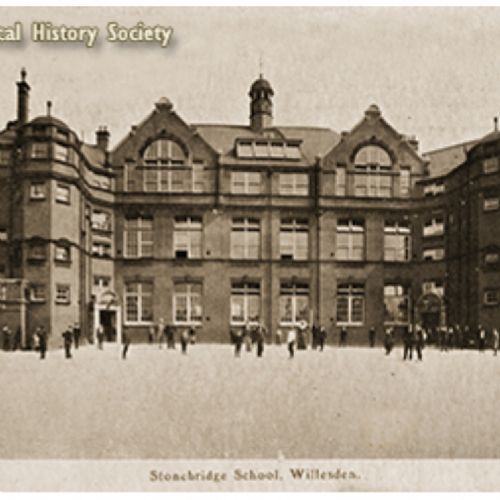
ER Robson, appointed as architect to the School Board for London (SBL) in 1871, developed the characteristic Queen Anne style as a secular alternative to the Gothic of Anglican schools. This interpretation of the red brick, sash windowed, vernacular idiom of houses of the late C17 and early C18 lent itself to a template for the large-scale designs required for schools, as well as for the large windows needed to light classrooms. Robson’s 1874 book ‘School Architecture’ was highly influential, and his standard Board School plan was widely emulated.
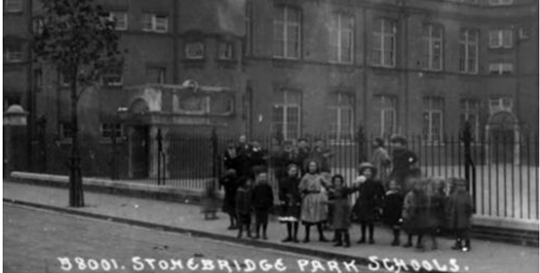
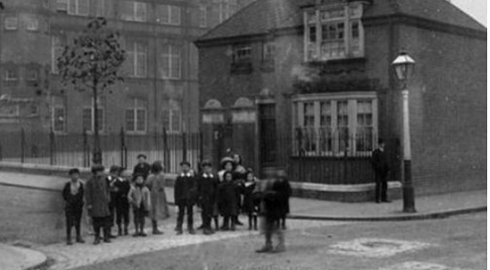
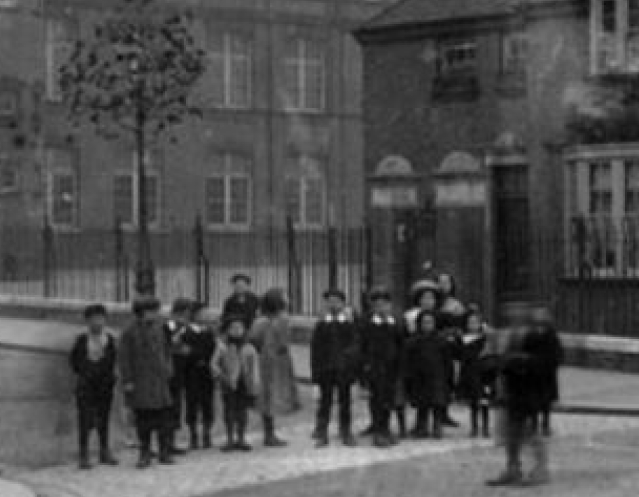
Until the late C19 Willesden was still on the rural fringes of London but was transformed into a densely built-up suburb of largely lower-middle and working-class housing after Willesden Junction station was opened in 1866. By the 1880s a clear deficiency in the number of voluntary school places available was emerging and, in the face of considerable opposition from local Anglican churches, the Education Department made an order for the compulsory formation of a school board in Willesden in 1882, and compelled the board to open a temporary school in the Wesleyan lecture hall in Harlesden in 1885, and to build its first board school there in 1891. Before it was superseded in 1904, Willesden School Board opened another 12, mainly large, schools and several special schools. The 15 voluntary schools provided 10,217 places and the board schools another 10,876.
George Evelyn Tidmarsh Laurence (1860-1922) was articled under FE Morris of Colchester and worked for 7 years as an assistant to ER Robson at the SBL. He designed several schools for the Willesden School Board and its successor body, Willesden Education Authority, and for Edmonton, Tottenham and Wood Green school boards, Middlesex. While evidently continuing to practise in London, Laurence became sole architect to the Swansea Education Authority c1891, for which he designed a number of schools, in which capacity he acted until his death.
SOURCES: A History of the County of Middlesex: Volume 7: Acton, Chiswick, Ealing and Brentford, West Twyford, Willesden (1982), pp. 247-254 Cherry, B and Pevsner, N, The Buildings of England, London 3: North West, 1991
Vacancies
Job Title: Headteacher of The Stonebridge School (September 2026 start)
Reporting to: Chair of Board of Governors
Salary: L18-L24 plus Inner London (£88,496 –£99,951 p.a) plus 7.5% additional payment (up to £7496.33)
Hours of Work: Full-time
At The Stonebridge School we offer an integrated, exciting and relevant curriculum which is enriched with a variety of experiences. We have high expectations and put children at the heart of everything we do and every decision we make. Through careful analysis, evaluation and review we ensure that all children make significant progress, are safe and reach their full potential. We value the contribution of all stakeholders, believing that collaboration and consistency is key and our commitment to training and development for the whole school community ensures that the service we offer will always advance. Through the balance of academic and value led education, which reflects our motto “learning for life” we will ensure our pupils are rounded and confident individuals who are equipped for their next educational journey and their place in the world.
Please see The job Advert and Candidate Pack below
The Stonebridge School Job Advert Spring 2026
The Stonebridge School Headteacher Candidate Pack Spring 2026