
Subjects
What is Jigsaw PSHE?
Jigsaw PSHE is a comprehensive and completely original Scheme of Work for the whole Primary School from Years F1 and 2 through to Year 6. It brings together PSHE Education, emotional literacy, social skills and spiritual development in a comprehensive scheme of learning.
SMSC (Spiritual, Moral, Social and Cultural) development opportunities are mapped throughout. All of these pieces of learning are brought together to form a cohesive picture, helping children to know and value who they are and understand how they relate to other people in the world. Information regarding this can be found below.
Jigsaw contributes, as a good PSHE programme should, to the British Values agenda very significantly, both through the direct teaching of information and through the experiential learning children will enjoy.
The 5 strands of the British Values agenda have been mapped across every Puzzle and every Piece (lesson). Information regarding this can be found below.
Jigsaw also helps to support the Prevent Strategy. The main way in which Jigsaw offers support is through the adoption of a whole-school approach; our school fosters a climate of mutual understanding and respect.
Objectives/Pupil learning intentions: Jigsaw PSHE will support the development of the skills, attitudes, values and behaviour, which enable pupils to:
- Have a sense of purpose
- Value self and others
- Form relationships
- Make and act on informed decisions
- Communicate effectively
- Work with others
- Respond to challenge
- Be an active partner in their own learning
- Be active citizens within the local community
- Explore issues related to living in a democratic society
- Become healthy and fulfilled individuals
There are 6 Puzzles (half-term units of work) each with 6 Pieces (lessons):
Autumn 1: Being Me In My World
Autumn 2: Celebrating Differences
Spring 1: Dreams and Goals
Spring 2: Healthy Me
Summer 1: Relationships
Summer 2: Changing Me

Intent
Science teaching at The Stonebridge School aims to give all children a strong understanding of the world around them whilst acquiring specific skills and knowledge to help them to think scientifically, to gain an understanding of scientific processes and also an understanding of the uses and implications of Science, today and for the future. Scientific enquiry skills are embedded in each topic the children study and these topics are revisited and developed throughout their time at school. Topics such as Plants are taught in Key Stage One and studied again in further detail throughout Key Stage Two.
All children are encouraged to develop and use a range of skills including observations, planning and investigations, as well as being encouraged to question the world around them and become independent learners in exploring possible answers for their scientific based questions. Specialist vocabulary for topics is taught and built upon, and effective questioning to communicate ideas is encouraged. Concepts taught should be reinforced by focusing on the key features of scientific enquiry, so that pupils learn to use a variety of approaches to answer relevant scientific questions.
Implementation
- Teachers use Developing Experts to aid their planning in Science.
- A knowledge organiser which outlines knowledge (including vocabulary) all children must master;
- A cycle of lessons for each subject, which carefully plans for progression and depth;
- A low stakes quiz which is tested regularly to support learners’ ability to block learning and increase space in the working memory;
- Challenge questions for pupils to apply their learning in a philosophical/open manner;
- Trips and visits from experts who will enhance the learning experience;
Impact:
Our Science Curriculum is high quality, well thought out and is planned to demonstrate progression. If children are keeping up with the curriculum, they are deemed to be making good or better progress. In addition, we measure the impact of our curriculum through the following methods:
A reflection on standards achieved against the planned outcomes;
Tracking of knowledge in pre and post learning quizzes;
Pupil discussions about their learning;
Learning about the environment
We use the outdoor classrooms. We are developing as an Eco-school, concern that has concern for society, the place of science in understanding the world, and the sustainability of the planet are key drivers.
Intent
At The Stonebridge School we aim to foster a deep understanding and appreciation of diverse religious beliefs and practices. We cultivate an environment where children explore, respect, and celebrate the richness of different faiths, enabling them to develop their own understanding of the world around them.
Our intent is to empower pupils with the knowledge, skills, and values to navigate a multicultural society, promoting tolerance, empathy, and a sense of community. Through the lenses of believing, behaving, and belonging, we aspire to instil in our pupils a curiosity about religious diversity, encouraging them to ask questions, challenge perspectives, and develop a sense of identity and belonging within a wider global context.
Implementation
Our curriculum is carefully crafted and is aligned with the DfE Religious education in English schools: statutory guidance 2010 and the Brent Agreed Syllabus for RE. We have adopted the Jigsaw curriculum and also utilise Planbee planning resources. Through this sequence, children have the opportunity to learn about the six major world religions – Christianity, Judaism, Islam, Hinduism, Sikhism, Buddhism – as well as Jainism, to reflect the diversity of our school community. Additionally, children are given the opportunity to consider the non-religious worldview of Humanism. RE is taught using probing enquiry questions, fostering deep thinking and exploration of religious concepts – giving children an opportunity to make links within and across different worldviews.
The fundamental British Values and Spiritual, Moral, Social, and Cultural (SMSC) elements are interwoven throughout the curriculum. Collective worship during assemblies further enriches our pupils’ experiences.
Impact
Success in our implementation is evident through the holistic development of our pupils. Pupils demonstrate a respectful understanding of diverse religious beliefs, displaying empathy, and embracing differences within our school and the wider community.
Regular assessment, reflective practices, and feedback mechanisms will help measure the depth of understanding, tolerance, and appreciation developed by our pupils.
At Stonebridge, every child deserves to be a confident, fluent, and resilient mathematician. We believe mathematics is not only a subject to be studied but a vital life skill essential for future success. Through the Maths Mastery approach with Ark Curriculum Plus, we ensure that pupils develop a deep, connected understanding of mathematical concepts and can confidently apply their knowledge in school, at home, and in the wider world. Our teachers are committed to delivering a consistent, research-informed curriculum that promotes reasoning, problem-solving, and fluency through the use of concrete, pictorial, and abstract representations. We provide high-quality professional development and resources to ensure teaching is engaging, inclusive, and ambitious for all learners.
Pupils at Stonebridge will:
- Develop fluency with number facts, procedures, and strategies.
- Apply knowledge to solve problems in varied contexts.
- Reason mathematically and explain their thinking with clarity.
- Build confidence, resilience, and enjoyment of mathematics.
- Recognise the importance of mathematics in everyday life and future careers.
Intent
We follow the mastery approach, delivered through Ark Curriculum Plus, characterised by:
- Small-step, carefully sequenced learning.
- Development of mathematical thinking and reasoning.
- Fluency and factual recall.
- Use of representations to expose mathematical structures.
- Ensuring all children can succeed, regardless of starting point.
Implementation
All children receive a daily maths lesson, although mathematical skills also run through many other areas of the curriculum.
- Each lesson focuses on one clear learning objective, which all children are expected to master. Extension activities enable children who grasp the objective rapidly to extend their learning by exploring it in greater depth.
- Lessons incorporate the Maths Mastery approach, enabling pupils to acquire a deep, long-term, and secure understanding of mathematics.
- Lesson sequences include elements of:
- Fluency – practising key skills and recall.
- Reasoning – deepening understanding through explanation and justification.
- Problem solving – applying skills to a variety of contexts.
- Whole-class teaching is adopted and children work in mixed-ability groups, ensuring access and challenge for all.
- All classrooms have mathematics displays with key questions, sentence stems, Star Words vocabulary, and an engaging Maths Meeting display to support learning and retrieval.
Concrete–Pictorial–Abstract (CPA) Approach
At Stonebridge, we use the CPA approach to secure conceptual understanding and progression from practical exploration to formal recording. Pupils are introduced to new concepts through hands-on resources, supported by visual representations, before moving to abstract notation. This consistent progression ensures depth of understanding and allows all children to access the mathematics.
- Every classroom has a range of practical apparatus to support children’s learning. Additional resources are stored centrally and are accessible to all.
- Manipulatives are used in all lessons, from EYFS through Key Stage 1 and Key Stage 2, to secure conceptual understanding and support progression.
Find more details about mathematics teaching in our policy here.
Intent
At Stonebridge our Geography curriculum explores the relationship between the world and the people in it. We want our children to see the links between nature (physical geography) and people (human geography) so that as they get older they assume their responsibility to look after the world as well as enjoy the wondrous landscapes, mountains and rivers as well as cultures in the many countries of the world’s continents. Our intention through the geography curriculum is that the school values of Tenacity, Respect, Ambition, Character and Kindness are demonstrated by all pupils. The school has developed its own curriculum by adapting two schemes and adding contextual themes to meet the needs of the community. The curriculum meets all the expectations of the National curriculum.
We want children to be ‘global citizens’ and be aware of how they impact the world through the choices they make as they become adults. The school has developed its own curriculum by adapting two schemes and adding contextual themes to meet the needs of the community. We have improved the content by adding a ‘global citizenship aspect so that children can look at how we can preserve the world in which we live through a focus on the UN Sustainable Goals. The curriculum meets all the expectations of the National curriculum.
Our intention is that all pupils
- Develop place and locational knowledge of globally significant places both marine and terrestrial as well a deep understanding of physical and human features and the geographical processes involved.
- Develop the necessary skills to interpret, collect analyse and communicate with a range of data gathered through fieldwork.
- To understand and respect the natural world and its resources and understand the interdependency of humans and physical geographical features and how these bring about spatial variations and change over time.
- To understand how our values and attitudes affect the natural world and be pro- active to protect it.
- Interpret a range of sources of geographical information, including maps, diagrams, globes, aerial photographs and Geographical Information Systems (GIS) and communicate geographical information in a variety of ways, including through maps, numerical and quantitative skills and writing at length
LEAP represents the curriculum principles that guide learning at our school: For more information, click here Curriculum principles.
- Language-Rich – We nurture confident communication by providing rich opportunities to talk, listen, and build vocabulary, enabling children to express ideas clearly and to a high standard.
- Experiential – We bring learning to life through hands-on experiences (trips, visits, art/design, and real-world exploration) that inspire curiosity and deepen understanding.
- Ambitious – We set the highest expectations for every learner, encouraging them to achieve their best and believe in their potential.
- Purposeful – We design learning that builds on prior knowledge, carefully addressing gaps to ensure meaningful, connected progress. Below is an outline of how these principles are dissimilated in geography.
Language Rich
- knowledge and understanding of new terms used in context of geography
- applying these terms in the correct context
- using learning environment to reinforce embed key dates, names and vocabulary linked to topic
Experiential Learning
- interviewing/meeting people who have experienced major changes/events
- exploring local history – visits and visitors
- exploring primary and secondary sources e.g. artefacts, journals, diaries,
- using role play to explore different perspectives
- educational visits and workshops to embed learning
- exploring local area / watching news /videos /visiting areas of geographical interest
- take part in ‘take action’ events
Ambition
- fostering a love of historical enquiry
- raising awareness of the impact of people on the world resources and action to counter act damage
- to use past events to drive forward change in the local area
- deriving questions through analysing various sources
Purposeful
- ask and answer questions to deepen learning
- taking ownership of their learning
- learning builds on prior learning
- pupils still needing foundational learning have their geography lessons adapted to meet and challenge them.
Implementation
Based on research of learning and working memory our curriculum is designed so that learning is built on over time. The curriculum is organised to address core themes that will be visited horizontally across a year group and vertically visited as children progress through the school.
Five core themes have been selected. These are Settlement and Population, Climate and Landscape, Sustainability and Trade.
Learning in Geography involves:
- Clear Core knowledge supported by the use of knowledge organisers.
- A clear purpose for the learning centred around a core theme e.g. settlement and population.
- Children acquiring knowledge through reading and discussion, use of artefacts, visits and visitors, taking notes and showing their knowledge through retrieval, testing and quizzing and where appropriate through essay type answers.
- Geography is taught as a discreet lesson using the medium-term plan to aid teacher’s planning.
Impact
The impact of the Geography curriculum will be measured in the following ways
- standards and quality of children’s learning is evaluated through learning reviews, knowledge assessments and outcomes in books.
- pupil voice – children able to confidently talk about their learning and recall recent and previous learning
- pupil voice – children able to show how historical knowledge is impacting on their choices as citizens
Reading
Reading is the gateway to all learning, and developing a strong reading culture is at the heart of everything we do. At Stonebridge Primary, our intent is to nurture a love of reading that inspires children to become confident, fluent, and enthusiastic readers who engage with a wide variety of texts.
Our carefully planned reading curriculum ensures full coverage of the National Curriculum, providing children with the skills and strategies needed to read with fluency, accuracy, and understanding. We aim to foster both the technical skills of reading and a lifelong enjoyment of literature, empowering children to see themselves as readers in every sense.
We are committed to providing a reading-rich environment that is stimulating, inclusive, and engaging, ensuring children have access to high-quality texts across a wide range of genres, cultures, and perspectives. Reading at Stonebridge is purposeful and meaningful, equipping children with the ability to explore new ideas, think critically, and develop empathy.
Through our reading curriculum, pupils not only learn to decode and comprehend but also to develop curiosity, creativity, and confidence as readers. By embedding reading into all aspects of the curriculum, we ensure children understand its importance in shaping learning, imagination, and future success.
Our pupils become confident, motivated readers by:
- Developing fluency and stamina through daily opportunities to read widely and often.
- Building a strong vocabulary and using it to deepen comprehension.
- Asking and answering meaningful questions about texts to demonstrate understanding.
- Making connections between what they read and their own experiences, the wider world, and other texts.
- Exploring diverse authors and texts to develop cultural awareness and broaden horizons.
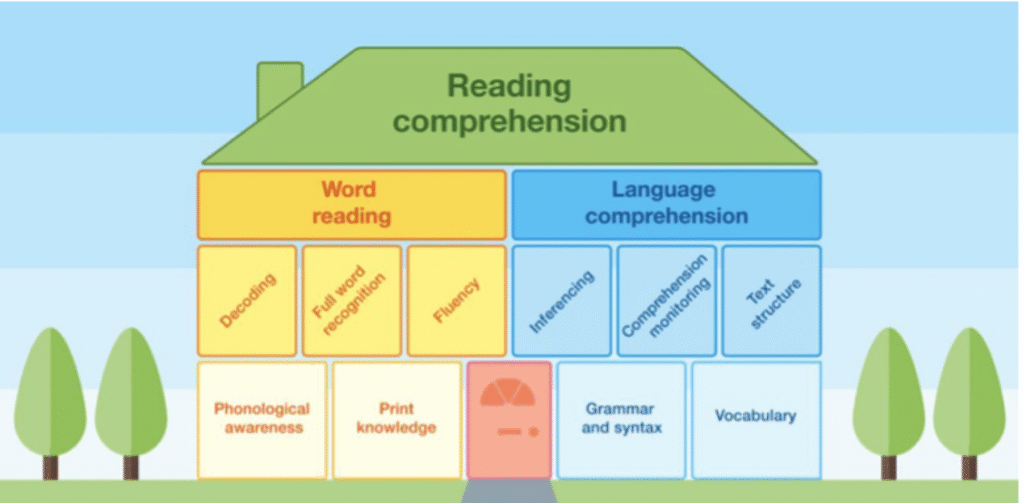
At The Stonebridge School, we understand that reading comprehension is broken into different skills blocks that children must master in order to read fluently and with confidence in all subjects and texts of different genres. These begin with the foundational knowledge (phonological awareness, print knowledge, grammar, and vocabulary building) that progresses to more complex reading skills (decoding, full word recognition, fluency, inference, comprehension monitoring, and test structure).
Word Reading (Phonics)
Children are taught a range of strategies in order to help them read fluently, including whole word reading, and phonics using the Read, Write, Inc. scheme. Phonics lessons are taught daily at a level appropriate to each child’s learning from Reception to year 2 where they learn to recognise and apply the sounds made by individual letters, e.g. m,s,a and by groups of letters e.g. -ay, -ee, -oo.
The children gradually learn to practise and apply their knowledge of sounds through reading a range of books and by writing simple sentences.
Children are given a statutory phonics test to assess their single word reading skills at the end of Year 1, Those who are still not secure with decoding after the end of Year 1 are given additional small group support.
At The Stonebridge School, we understand that reading comprehension is broken into different skills blocks that children must master in order to read fluently and with confidence in all subjects and texts of different genres. These begin with the foundational knowledge (phonological awareness, print knowledge, grammar, and vocabulary building) that progresses to more complex reading skills (decoding, full word recognition, fluency, inference, comprehension monitoring, and test structure).
Language Comprehension
Comprehension is understanding the meaning of written language. Whilst the phonetic knowledge supports pupils to be able to read and spell the words they see; comprehension practice supports pupils to understand what those words are and what they mean when put together in a phrase or sentence.
Comprehension is central to reading and children are given opportunities to improve their skills through a range of whole class (shared reading) and small group (guided reading) opportunities.
We provide children with opportunities to read and listen to a range of carefully selected high quality texts which stimulate them as readers, writers, and thinkers. These include detailed close reading of selected passages, oral and written re-telling of texts and targeted questions to build their retrieval skills and deeper understanding of a text.
All children are encouraged to read widely across both fiction and non-fiction so that they are exposed to several forms of texts, genres and structures as well as develop their knowledge across the curriculum and of the world in which they live in.
Writing
At The Stonebridge School, we aim for our children to read and write with fluency and assured control in order to grow as confident communicators with an understanding on how to use a range of independent strategies to self – monitor and self- correct. Our English curriculum is designed to offer children opportunities to understand a range of text types and genres and be able to write in a variety of styles and forms. We encourage children to have an interest in words and their meaning in order for them to develop a growing vocabulary, which is an essential component when communicating a message with precision.
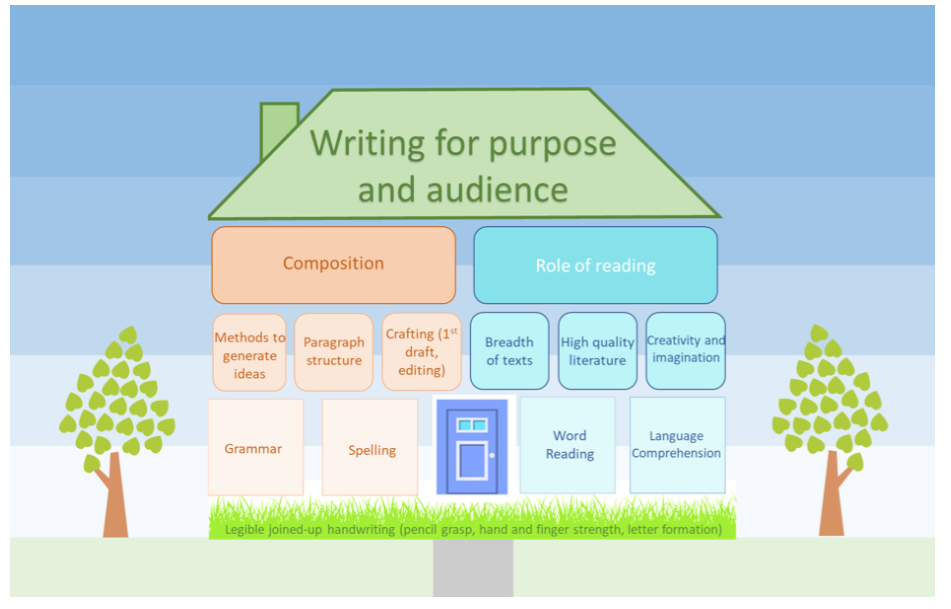
Image to show all the components needed to write for an audience- EEF Foundation
Role of Reading
Our English curriculum has been written to ensure that children have effective models to draw on in their own writing. The way writing is taught allows children think as writers with audience and purpose in mind. We also acknowledge that the more children read, the better they can build up and expand their knowledge. They can be open to new ideas and have an understanding of new things. This encourages creativity and imagination that allows children to innovate their writing.
Composition
Composition is the way a writer crafts words, sentences, and paragraphs to create a coherent piece of writing. A typical unit of work in English lasts 3 weeks and after an initial period of immersion in the text, children produce a complex extended piece of writing. To do this, they have the chance to generate ideas, plan, write, edit, and rewrite over several weeks working using models and detailed feedback from staff or peers. Effective composition involves articulating and communicating ideas, and then organising them coherently for a reader. This requires clarity, awareness of the audience and purpose as well as a wide knowledge of vocabulary and grammar.
Please read the school’s English Writing Journey for further detail on how the process of a writing unit.
Children are taught to write in a variety of styles in context such as narrative, persuasive, journalistic, recounts and reports. Children learn how to vary sentences, make interesting and ambitious word choices, and use grammar and punctuation correctly drawing upon their reading.
As part of the writing process, children have opportunities to develop their spoken language. As part of the ‘Immersion’ phase, children engage in discussions about the text where they articulate and justify answers, arguments and opinions as well as ask relevant questions to extend their understanding and knowledge. Through drama, role-play and hot-seating strategies, children use spoken language to get into a role of a character to empathise. Through debates, discussions and presentations, children participate actively in conversations and use spoken language to speculate and explore ideas.
Handwriting
Good handwriting is an essential skill in the quest to spell and write fluently, confidently and competently. A joined handwriting style links kinaesthetic ‘muscle memory’ with the relationship between the sounds of our speech and the letter shapes, letter groupings and whole written words. Children are taught how to form letters using a progressive scheme Penpals which ranges from EYFS to year 6.
Intent
Design and technology is an inspiring, rigorous and practical subject. Using creativity and imagination our pupils will design and make products that solve real and relevant problems within a variety of contexts, considering their own and others’ needs, wants and values. They will draw on disciplines such as mathematics, science, computing and art. Pupils will learn how to take risks, becoming resourceful, innovative, enterprising and capable citizens. Through the evaluation of past and present design and technology, they will develop a critical understanding of its impact on daily life and the wider world. High-quality design and technology education makes an essential contribution to the creativity, culture, wealth and well-being of the nation; they will know that Design and Technology solves problems and enriches lives!
Implementation
We use the KAPOW scheme to teach Design and Technology. Topics will be taught in the order outlined in the curriculum overview. Teachers must identify the most appropriate teaching strategy to suit particular learning. All lessons for one topic are to be planned on a flipchart using Active software/Smart Board using the medium term plans from the KAPOW scheme. When planning a unit consideration should be made of the following;
- Developing children’s designing skills, including generating and developing ideas, clarifying their task;
- creating design proposals, communicating ideas, planning and evaluating;
- Acquiring and refining the practical skills associated with making, including working with materials and components, tools and processes, for example by planning, measuring and marking out, cutting and shaping, joining and combining, finishing, and evaluating;
- Application of mathematical skill, for example by measuring to an appropriate number of decimal places, drawing and interpreting tables, graphs and bar charts;
- Application of Computing, for example by making things happen by the use of control, handling information through the use of a database or spread sheet;
- Application of art skill, for example by investigating texture and colour or recording visual information.
- Teachers must decide what the Polished Product will be for every unit.
Impact
Our Design and Technology Curriculum is developing to provide well thought out lessons and topics that demonstrate progression. In addition, we measure the impact of our curriculum through the following methods:
- reflection on standards achieved against the planned outcomes
- pupil voice about their learning, which includes discussion of their thoughts, ideas and evaluations of work.
- As designers, pupils will develop skills and attributes they can use beyond school and into adulthood.
Pupils learn how to take risks, becoming resourceful, innovative, enterprising and capable citizens. Through the evaluation of past and present Design and Technology, they develop a critical understanding of its impact on daily life and the wider world. High-quality Design and Technology education makes an essential contribution to the creativity, culture, wealth and well-being of the nation.
Intent
The intent of the Computing curriculum is that children are taught to become safe, competent and independent users of various technologies, internet services and programming. Our curriculum is tailored for the needs of all our children and community whilst upholding high standards for progression and achievement. Our curriculum principles of LEAP are interwoven into the computing curriculum as outlined below as they were designed to address the barriers that our children come to our school with.
Language Rich
- key vocabulary is explicitly explained using visual cues, rehearsed together as a class, and displayed at all times on working walls when relevant.
- whole-class oral rehearsal supports precise subject specific language and deepens conceptual understanding.
- pupils are encouraged to feedback using subject specific vocabulary and during projects that they under take.
- talk Tasks are modelled by the teacher and rehearsed in mixed ability groups, providing further scaffold for children’s language development
Experiential Learning
- technology is shown to be all around us and pupils are encouraged to make these real-world connections in every unit.
- linked to Conceptual Understanding: pupils explore technological ideas through concrete manipulatives and pictorial models before moving to abstract representations.
- pupils are encouraged to discuss their own prior experiences of ICT and links to other subjects such as DT and history are made.
- pupils utilize real life resources such as Bee bots, computers, cameras etc. as well as online software for hands on experiences.
Ambitious
- all pupils are expected to access a computing curriculum whilst at The Stonebridge School.
- lessons are designed with depth, not speed, ensuring all children master core concepts before moving on.
- enrichment and challenge are embedded so that pupils develop resilience, independence, and a belief in their own ability to achieve knowing that the future of technology will rely on them.
- the curriculum meets the NC curriculum and the EAD strands of the EYFS curriculum.
Purposeful
- we design learning that builds on what children already know, carefully addressing gaps to ensure meaningful and connected progress.
- EAL and SEND learners will are still learning foundations will be exposed to a curriculum that meets their needs and challenges them.
Implementation
At the Stonebridge School, we teach an inclusive and ambitious curriculum that covers the knowledge and skills outlined in the National Curriculum while focusing on its three aspects:
Computer Science: this is the core of the Computing curriculum and covers principles like algorithms, programming (e.g. BeeBots/MBots and Scratch) and data representation, as well as understanding how computer systems and networks function.
Information Technology: the effective use of computing technology for functional purposes e.g. creating music, videos and animations, saving, organising and retrieving work, blogging, manipulating data.
Digital Literacy: the safe and responsible use of technology, including Online Safety, online identity, understanding digital footprint and online risks relating to Content, Contact, Conduct and Commerce.
Computing is taught as a discreet subject for up to 1 hour a week in either our well-resourced Computing Suite or through a range of other resources or as unplugged lessons without using a hands-on digital device. Children have access to iPads, computers to compliment and enhance computing across the curriculum. These are used for research and to complete online quizzes. As a school, we also subscribe to the London Grid for Learning [LGfL] which provides the children with access to high-quality, cross-curricular learning resources that allow our pupils to consolidate and extend their learning in school and at home. In the Early Years, the children’s learning of Computing is centred on play-based, unplugged activities that focus on developing their speaking and listening, curiosity, problem-solving and creativity.
We primarily use the National Centre for Computing Education’s [NCCE] Teach Computing curriculum to deliver our Computing lessons. It is a spiral curriculum, which means that children revisit the same concepts at least once each academic year to ensure that these are well-embedded and that the learners acquire knowledge that builds on previous knowledge.
Teachers assess learners in each lesson and plan opportunities for them to remember more through regular retrieval practice at the start and during each lesson. Online safety is a key part of the curriculum and is a continued focus throughout the year.
Impact
Learning in Computing will be enjoyed across the school. Teachers will be able to show evidence of children’s learning in the subject. Our children will be confident users of a range of digital devices and technologies both software and hardware to produce digital outcomes. Our pre-secondary pupils will leave Stonebridge as knowledgeable, responsible and confident users of technology.
Formative assessment is used by the class teacher and teaching assistant during whole class or group teaching. Children’s achievement and level of confidence is taken into consideration to inform future planning.
Intent
We are committed to offering a high-quality curriculum that provides an appropriate balance of spoken and written language and lays the foundations for further foreign language teaching at KS3. Through the curriculum we aim that children:
- understand and respond to spoken and written language from a variety of authentic sources
- speak with increasing confidence, fluency and spontaneity, finding ways of communicating what they want to say, including through discussion and asking questions, and continually improving the accuracy of their pronunciation and intonation
- can write at varying length, for different purposes and audiences, using the variety of grammatical structures that they have learnt
- discover and develop an appreciation of a range of writing in the language studied.
Implementation
Children are introduced to Spanish from Y3 in a weekly 60 minute lesson over 2 terms. Prior to this in KS1 children learn French songs and rhymes in Music. Lessons across Key Stage 2 support the skills of speaking, listening, reading and writing and are taught by via a scheme written by native Spanish speakers for non-specialist teachers.
Key vocabulary is taught and learning is deepened through retrieval practice, low stakes testing to show impact of learning.
Impact
Our MFL curriculum ensures that children develop their knowledge of where different languages, including the range of home languages spoken by the families of the school, as well as Spanish, are spoken in the world.
Intent
We are committed to offering a high-quality curriculum that provides an appropriate balance of spoken and written language and lays the foundations for further foreign language teaching at KS3. Through the curriculum we aim that children:
- understand and respond to spoken and written language from a variety of authentic sources
- speak with increasing confidence, fluency and spontaneity, finding ways of communicating what they want to say, including through discussion and asking questions, and continually improving the accuracy of their pronunciation and intonation
- can write at varying length, for different purposes and audiences, using the variety of grammatical structures that they have learnt
- discover and develop an appreciation of a range of writing in the language studied.
Implementation
Children are introduced to Spanish from Y3 in a weekly 60 minute lesson over 2 terms. Prior to this in KS1 children learn French songs and rhymes in Music. Lessons across Key Stage 2 support the skills of speaking, listening, reading and writing and are taught by via a scheme written by native Spanish speakers for non-specialist teachers.
Key vocabulary is taught and learning is deepened through retrieval practice, low stakes testing to show impact of learning.
Impact
Our MFL curriculum ensures that children develop their knowledge of where different languages, including the range of home languages spoken by the families of the school, as well as Spanish, are spoken in the world.